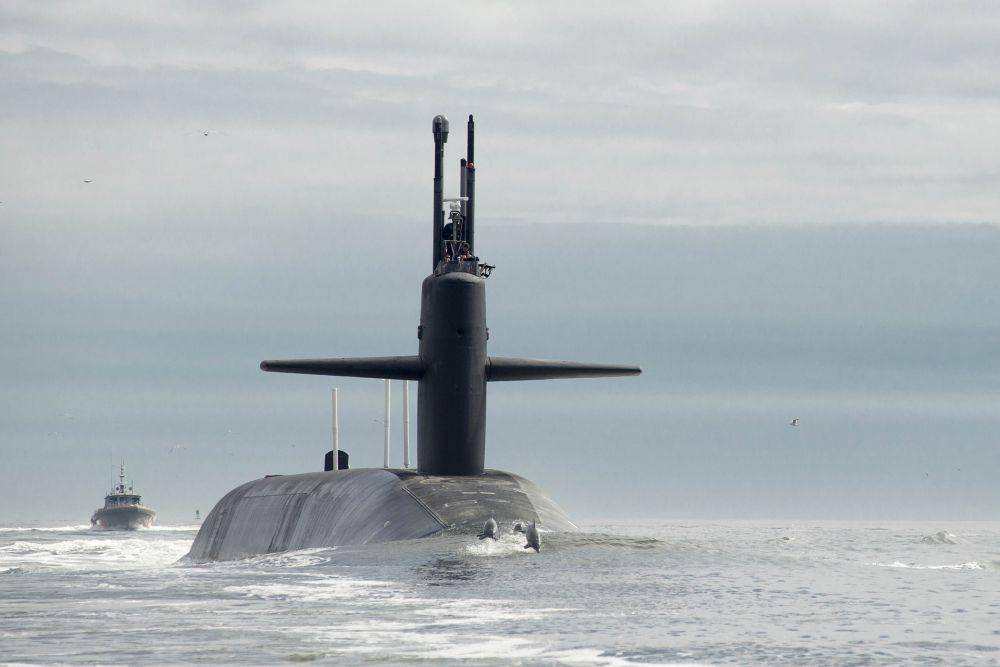
A submarine (or sub) is a watercraft capable of independent operation underwater. It differs from a submersible, which has more limited underwater capability.[1] The term is also sometimes used historically or colloquially to refer to remotely operated vehicles and robots, as well as medium-sized or smaller vessels, such as the midget submarine and the wet sub. Submarines are referred to as boats rather than ships irrespective of their size.[2]
Although experimental submarines had been built earlier, submarine design took off during the 19th century, and they were adopted by several navies. They were first widely used during World War I (1914–1918), and are now used in many navies, large and small. Military uses include attacking enemy surface ships (merchant and military) or other submarines, and for aircraft carrier protection, blockade running, nuclear deterrence, reconnaissance, conventional land attack (for example, using a cruise missile), and covert insertion of special forces. Civilian uses include marine science, salvage, exploration, and facility inspection and maintenance. Submarines can also be modified for specialized functions such as search-and-rescue missions and undersea cable repair. They are also used in tourism and undersea archaeology. Modern deep-diving submarines derive from the bathyscaphe, which evolved from the diving bell.
Most large submarines consist of a cylindrical body with hemispherical (or conical) ends and a vertical structure, usually located amidships, that houses communications and sensing devices as well as periscopes. In modern submarines, this structure is the "sail" in American usage and "fin" in European usage. A "conning tower" was a feature of earlier designs: a separate pressure hull above the main body of the boat that allowed the use of shorter periscopes. There is a propeller (or pump jet) at the rear, and various hydrodynamic control fins. Smaller, deep-diving, and specialty submarines may deviate significantly from this traditional design. Submarines dive and resurface by means of diving planes and changing the amount of water and air in ballast tanks to affect their buoyancy.
Submarines encompass a wide range of types and capabilities. They include small autonomous examples using A-Navigation and one- or two-person subs that operate for a few hours, to vessels that can remain submerged for six months—such as the Russian Typhoon class, the biggest submarines ever built. Submarines can work at greater depths than are survivable or practical for human divers.[3]
History
Main article: History of submarines
Etymology
The word submarine simply means 'underwater' or 'under-sea' (as in submarine canyon, submarine pipeline) though as a noun it generally refers to a vessel that can travel underwater.[4] The term is a contraction of submarine boat.[5][6] and occurs as such in several languages, e.g. French (sous-marin), and Spanish (submarino), although others retain the original term, such as Dutch (Onderzeeboot), German (Unterseeboot), Swedish (Undervattensbåt), and Russian (подводная лодка: podvodnaya lodka), all of which mean 'submarine boat'. By naval tradition, submarines are still usually referred to as boats rather than as ships, regardless of their size.[2] Although referred to informally as boats,[7][8] U.S. submarines employ the designation USS (United States Ship) at the beginning of their names, such as USS Alabama. In the Royal Navy, the designation HMS can refer to "His Majesty's Ship" or "His Majesty's Submarine", though the latter is sometimes rendered "HMS/m"[9][Note 1] and submarines are generally referred to as boats rather than ships.[Note 2]
Early human-powered submersibles
An early submersible craft, built by Cornelis Drebbel, propelled by oars.
16th and 17th centuries
According to a report in Opusculum Taisnieri published in 1562:[10]
Two Greeks submerged and surfaced in the river Tagus near the City of Toledo several times in the presence of The Holy Roman Emperor Charles V, without getting wet and with the flame they carried in their hands still alight.[11]
In 1578, the English mathematician William Bourne recorded in his book Inventions or Devises one of the first plans for an underwater navigation vehicle. A few years later the Scottish mathematician and theologian John Napier wrote in his Secret Inventions (1596) that "These inventions besides devises of sayling under water with divers, other devises and strategems for harming of the enemyes by the Grace of God and worke of expert Craftsmen I hope to perform." It's unclear whether he ever carried out his idea.[12]
Jerónimo de Ayanz y Beaumont (1553–1613) created detailed designs for two types of air-renovated submersible vehicles. They were equipped with oars, autonomous floating snorkels worked by inner pumps, portholes and gloves used for the crew to manipulate underwater objects. Ayanaz planned to use them for warfare, using them to approach enemy ships undetected and set up timed gunpowder charges on their hulls.[13]
The first submersible of whose construction there exists reliable information was designed and built in 1620 by Cornelis Drebbel, a Dutchman in the service of James I of England. It was propelled by means of oars.[12]
18th century
By the mid-18th century, over a dozen patents for submarines/submersible boats had been granted in England. In 1747, Nathaniel Symons patented and built the first known working example of the use of a ballast tank for submersion. His design used leather bags that could fill with water to submerge the craft. A mechanism was used to twist the water out of the bags and cause the boat to resurface. In 1749, the Gentlemen's Magazine reported that a similar design had initially been proposed by Giovanni Borelli in 1680. Further design improvement stagnated for over a century, until application of new technologies for propulsion and stability.[14]
The first military submersible was Turtle (1775), a hand-powered acorn-shaped device designed by the American David Bushnell to accommodate a single person.[15] It was the first verified submarine capable of independent underwater operation and movement, and the first to use screws for propulsion.[16]
19th century
1806 illustration by Robert Fulton showing a "plunging boat"
In 1800, France built Nautilus, a human-powered submarine designed by American Robert Fulton. They gave up on the experiment in 1804, as did the British, when they reconsidered Fulton's submarine design.
In 1850, Wilhelm Bauer's Brandtaucher was built in Germany. It remains the oldest known surviving submarine in the world.[17]
In 1864, late in the American Civil War, the Confederate navy's H. L. Hunley became the first military submarine to sink an enemy vessel, the Union sloop-of-war USS Housatonic, using a gun-powder-filled keg on a spar as a torpedo charge. The Hunley also sank, as the explosion's shock waves killed its crew instantly, preventing them from pumping the bilge or propelling the submarine.[18]
In 1866, Sub Marine Explorer was the first submarine to successfully dive, cruise underwater, and resurface under the crew's control. The design by German American Julius H. Kroehl (in German, Kröhl) incorporated elements that are still used in modern submarines.[19]
In 1866, Flach was built at the Chilean government's request by Karl Flach, a German engineer and immigrant. It was the fifth submarine built in the world[20] and, along with a second submarine, was intended to defend the port of Valparaiso against attack by the Spanish Navy during the Chincha Islands War.















![[QUIZ] Dari Karakter Upin Ipin, Ini Cara Kamu Handle Tekanan di Tempat Kerja](https://image.rujakcingur.com/post/20260702/upload_e5a6eb4f19678225331e53a1f4f5a2b3_a649e6a0-263d-4301-b86b-705f8e7a268f.jpeg)



![[QUIZ] Cara Kamu Mengatasi Konflik Mirip Karakter 'Upin & Ipin' Ini](https://image.rujakcingur.com/post/20260526/upload_3ebe829817a4d354eaa3436b1a38c730_02a46673-66b7-4894-828b-8cea8ce1d985.jpeg)